
What does the ADA cover?
The Americans with Disabilities Act (ADA) is a comprehensive federal civil rights law that prohibits discrimination against individuals with disabilities and ensures equal access, opportunity, and participation in virtually all areas of public life. Enacted in 1990 and expanded through subsequent amendments, the ADA applies to public accommodations, commercial facilities, state and local government services, employment, telecommunications, and transportation systems, requiring that people with disabilities be afforded the same rights, privileges, and services available to the general public. The ADA covers architectural and structural accessibility, including entrances, ramps, restrooms, parking areas, signage, pathways, sales and service counters, seating, public-use areas, and means of egress. It establishes standards for effective communication, mandating accommodations such as auxiliary aids, interpreters, accessible formats, and assistive technologies. In employment, the ADA requires reasonable accommodations and prohibits discriminatory hiring, firing, and workplace practices. It also regulates website and digital accessibility under evolving interpretations of “public accommodations,” requiring businesses to ensure that their online content, tools, and services are accessible to individuals with visual, auditory, cognitive, and mobility impairments. The law mandates barrier removal when it is readily achievable, outlines compliance obligations for new construction and alterations, and provides strict enforcement mechanisms through the Department of Justice, private civil actions, and oversight agencies. In essence, the ADA ensures that individuals with disabilities can participate fully in society; physically, economically, socially, and digitally—by requiring businesses, employers, and government entities to uphold inclusive and accessible environments.
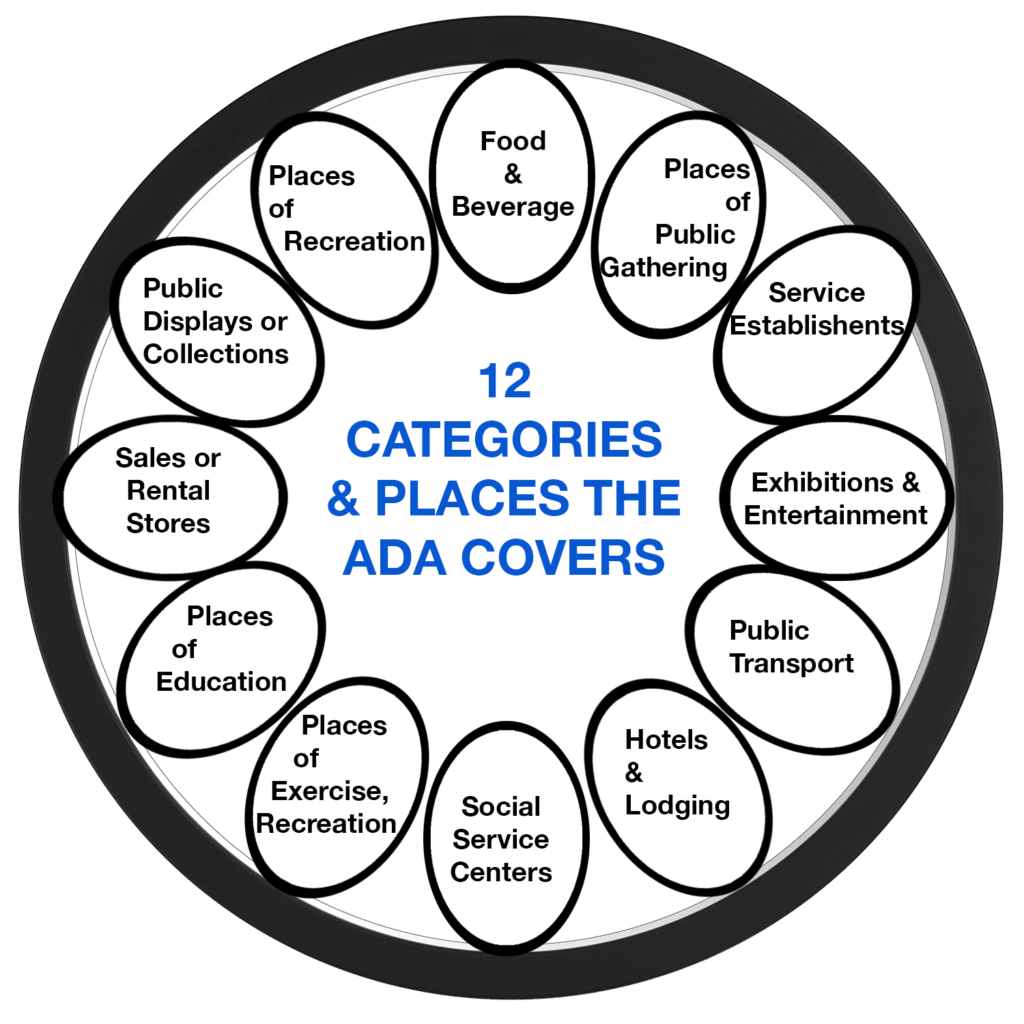
| Public accommodations under the ADA encompass a wide range of private businesses and facilities that are open to the general public, including but not limited to restaurants, bars, hotels, motels, theaters, stadiums, retail stores, shopping centers, service establishments, professional offices (such as doctors, dentists, lawyers, and accountants), museums, libraries, parks, zoos, amusement parks, private schools, daycares, transportation terminals, banks, gas stations, gyms, spas, recreational facilities, golf courses, social service centers, homeless shelters, and places of public gathering or entertainment. These establishments are required to provide equal access and remove physical and communication barriers when readily achievable, ensuring individuals with disabilities have the same ability to enter, navigate, and use the goods, services, and amenities offered to the public. |
A place of public accommodation must comply with ADA accessibility requirements under several circumstances, including all new construction, which must be fully designed and built to meet current ADA Standards from the outset. Compliance is also required when a facility built before 1991 undergoes a substantial remodel, alteration, or renovation, such as modifying entrances, restrooms, seating areas, counters, parking lots, or any element that affects usability; in these cases, the altered portions must be brought up to current ADA specifications, and additional path-of-travel improvements may also be required when readily achievable. Likewise, when a new business purchases, leases, or occupies an existing space, the business inherits the obligation to ensure the facility is accessible, and must remove barriers, make improvements, or upgrade deficient features to the extent that doing so is readily achievable, even if the building itself pre-dates the ADA. Whether it is a newly constructed facility, a major renovation, or the opening of a new business in an older space, the ADA requires that accessibility be integrated into the environment so individuals with disabilities can access and use the goods and services offered.
| Businesses must make accommodations for a broad range of disabilities under the ADA, including mobility impairments such as those requiring wheelchairs, walkers, crutches, or other assistive devices; sensory disabilities including blindness, low vision, deafness, hard of hearing, and speech impairments; and neurological, cognitive, and intellectual disabilities such as autism, traumatic brain injuries, learning disabilities, ADHD, and developmental conditions. The ADA also protects individuals with mental health disabilities—including anxiety disorders, PTSD, and depression—as well as those with chronic illnesses or physiological impairments such as epilepsy, diabetes, respiratory disorders, cardiovascular conditions, and other conditions that substantially limit a major life activity. It additionally covers individuals with temporary impairments when the condition is severe enough to restrict major life functions. Accommodations may include accessible routes, visual and tactile signage, assistive listening systems, service animal access, communication aids, barrier removal, policy modifications, or any reasonable steps necessary to ensure individuals with disabilities can access and use the goods, services, and opportunities the business provides. |
____________________________
SERVICE ANIMAL DISCLOSURE AND COMPLIANCE STATEMENT
Under the Americans with Disabilities Act (ADA), Title III – 28 C.F.R. § 36.104 and § 36.302, a service animal is defined strictly as a dog (and in limited circumstances, a miniature horse under § 36.302(c)(9)) that has been individually trained to perform a specific task or work directly related to an individual’s disability. Service animals are not pets; they are working animals trained to assist individuals with disabilities such as mobility impairments, blindness or low vision, deafness or hearing impairments, PTSD, seizure disorders, diabetes, and other physical, psychiatric, or neurological disabilities. The tasks they perform may include guiding a person who is blind, alerting someone who is deaf, pulling a wheelchair, retrieving items, reminding individuals to take medication, interrupting self-harm behaviors, providing deep-pressure grounding during panic attacks, alerting to oncoming seizures, or other trained, disability-mitigating functions.
Under ADA Title III regulations (28 C.F.R. § 36.302(c)), when the need for a service animal is not obvious, a business or public accommodation may ask only two questions to verify the legitimacy of a service animal:
- “Is the animal a service animal required because of a disability?”
- “What work or task has the animal been trained to perform?”
Businesses may not ask for documentation, certification, IDs, special vests, proof of training, details about the person’s disability, or require the animal to demonstrate its tasks.
It is important to note that Emotional Support Animals (ESAs), therapy animals, comfort animals, or companion animals are not recognized as service animals under the ADA. ESAs do not require training to perform a specific task related to a disability and therefore are not granted public-access rights under ADA Title III. While ESAs may receive certain housing protections under the Fair Housing Act (FHA) and limited protections in air travel under the Air Carrier Access Act (ACAA) (with recent restrictions), they are not covered by the ADA for entry into businesses, restaurants, stores, hotels, or other public accommodations.
Under 28 C.F.R. § 36.302(c), businesses must allow legitimate service animals to accompany individuals with disabilities in all areas where the public is allowed, unless the animal is out of control, not housebroken, or poses a direct threat to health or safety. However, ESAs may be lawfully excluded, as they are not protected under ADA public-accommodation rules, the lone ESA exception is housing under applicable Fair Housing laws which generally require all types of housing to allow an ESA without a deposit or additional rent or fees.
| The ADA also extends to the workplace, covering every stage of the employment process—from job application and hiring to day-to-day work, breaks, training, and all ongoing interactions with an employer. Under Title I of the ADA, employers must ensure that applicants with disabilities have equal access to the hiring process, and they may not discriminate based on disability in interviews, testing, or job offers. Once employed, individuals with disabilities are entitled to reasonable accommodations that enable them to perform essential job functions, which may include modified schedules, assistive technology, accessible workspaces, job restructuring, or policy adjustments. The ADA further requires interactive, ongoing communication between employer and employee to evaluate needs, address limitations, and maintain accommodations over time. These protections apply throughout the entire employment relationship, including during work activities, breaks, training sessions, advancement opportunities, and any employment-related programs or benefits, ensuring that individuals with disabilities are treated fairly and are able to participate fully in the workplace. |