
Strategic ADA Risk Analysis and Compliance Evaluation
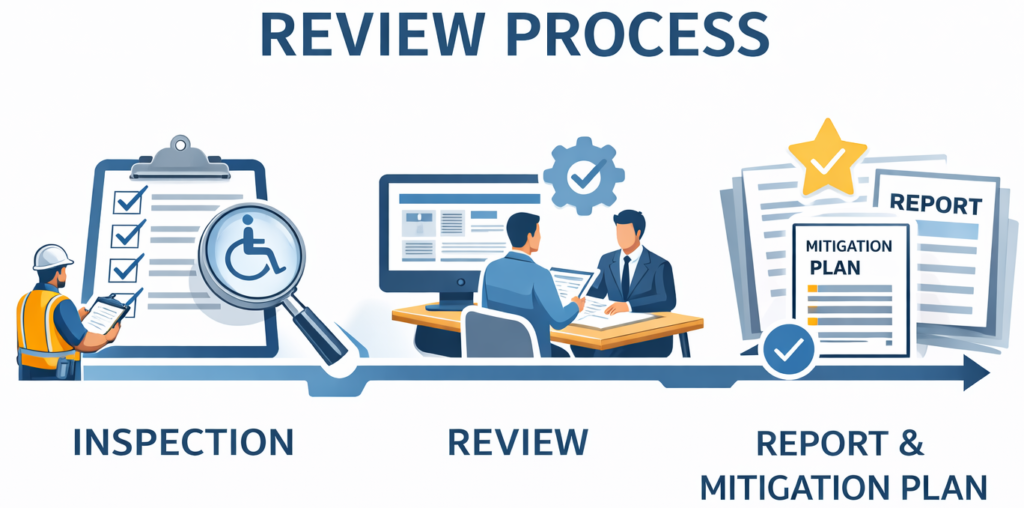
At Cabit ADA Risk Management, the inspection is only the beginning.
The true value of our service lies in our structured Review Process, where our engineers, ADA Coordinators, Registered Accessibility Specialists and Risk Management Specialists carefully analyze the data collected during inspection within the broader context of your business operations, property structure, and regulatory obligations.
Accessibility compliance is not a mechanical measurement exercise. It requires technical interpretation, professional judgment, and a practical understanding of how the law applies to real-world environments.


Integrating the Full Risk Profile
Following the on-site inspection, our team consolidates all measured conditions, observational findings, staff interviews, digital accessibility considerations, and policy documentation into a unified assessment framework. Measurements are not reviewed in isolation. Observations are not treated as standalone findings.
Instead, we evaluate your business as a complete accessibility system that includes physical, operational, and procedural components.
Every property has unique characteristics. Every business model presents different accessibility dynamics. Our review process accounts for those differences.
Context Matters
During review, we carefully examine the structure and nature of the physical property, including its layout, age, design constraints, and any prior alterations. We also evaluate how the business operates within that environment, including customer flow, service delivery methods, employee workspace arrangements, and operational realities.
A technical standard may appear straightforward on paper. In practice, application often requires interpretation within the context of feasibility, proportionality, and operational capability.
Our experts take those realities into consideration.
Regulatory Interpretation and Professional Judgment
The ADA includes minimum legal standards, but compliance does not exist in a vacuum. Industry best practices, Department of Justice interpretations, enforcement patterns, and employment-related obligations all influence risk exposure.
Our review process considers applicable federal standards, relevant state requirements where appropriate, industry best practices, readily achievable barrier removal standards, reasonable modification obligations, employment-related accommodation duties, and potential undue burden or technical infeasibility considerations.
Where legitimate exceptions may apply, our team carefully evaluates whether those exceptions can be substantially demonstrated and verified through documentation and measurable evidence.
We do not assume noncompliance where qualifying reasons may exist. At the same time, we do not minimize exposure where correction is clearly warranted. Balanced analysis is essential.
Structured Scoring and Risk Marking
As part of the review process, each item identified during inspection is formally marked, categorized, and scored within our internal evaluation framework.
This scoring system considers severity, usability impact, frequency of interaction, litigation exposure, and practical feasibility of remediation. Items are not simply labeled as pass or fail. They are evaluated in terms of risk weight and mitigation priority.
This allows leadership to make informed, strategic decisions rather than reacting to isolated deficiencies.
From Review to Deliverables
Once our Review Process is complete, it becomes the foundation for your formal Inspection Report.
The report reflects verified inspection findings, contextual regulatory analysis, risk classification and prioritization, and documented measurements and observations.
Based on this structured review, we then develop your customized Risk Mitigation Plan, outlining strategic, phased, and defensible corrective actions aligned with your business’s operational capabilities and legal obligations.
The inspection gathers data.
The review interprets it.
The report documents it.
The mitigation plan implements it.
The Outcome
The final product of our Review Process is a structured, defensible evaluation that provides clarity, prioritization, and decision-making guidance.
It supports leadership in understanding where risk exists, where exceptions may apply, and how to implement mitigation in a way that protects both operational stability and long-term compliance posture.